What is a sewer lateral and who is responsible for repairing it?
A sewer lateral is the pipe that carries waste from your house to the main sewer line. You usually hear the term when a camera shows a crack, or when every drain in the house backs up at once.
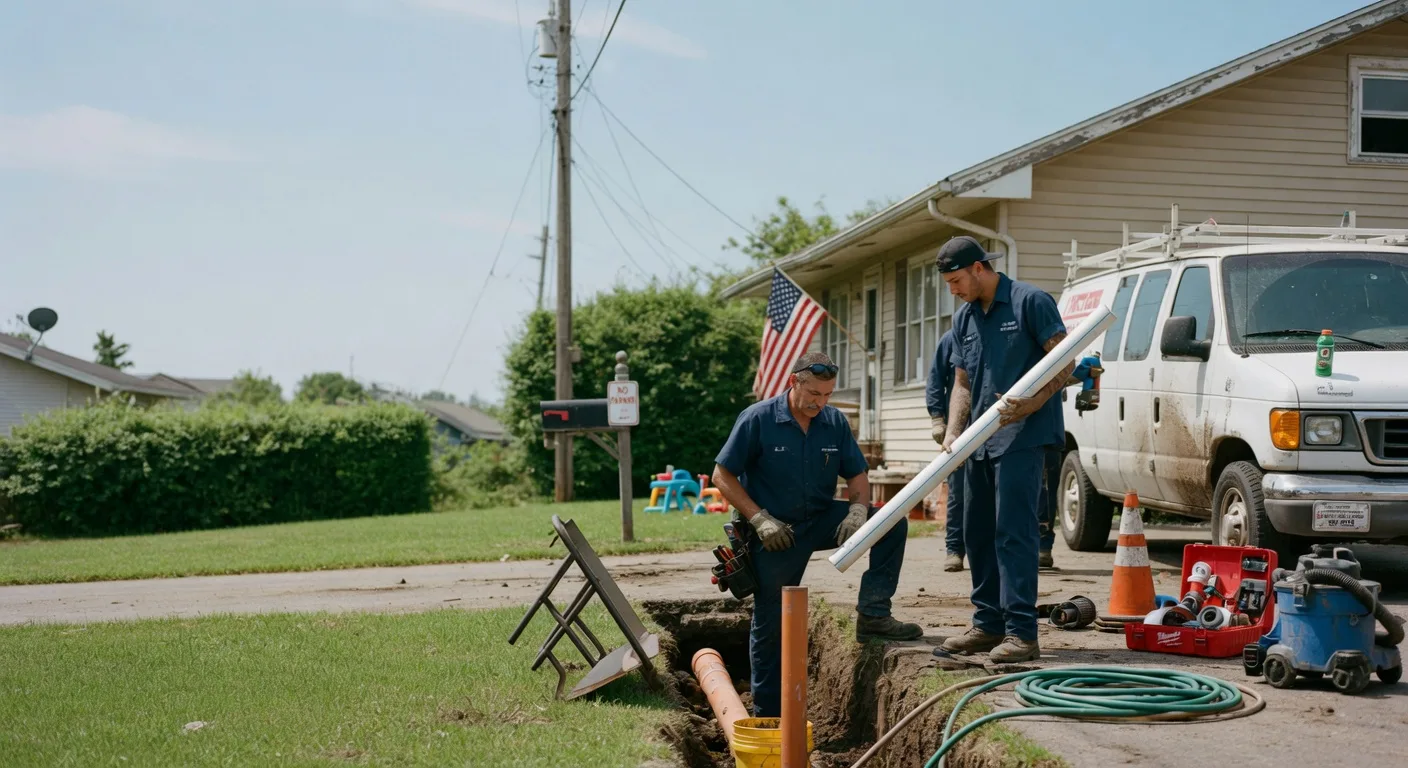
It starts where your drain lines leave the building and runs underground to the connection with the main. Older laterals are often clay, cast iron or fibre pipe, and they fail in familiar ways. Roots work into a clay joint. The pipe sags into a belly that holds water. A section cracks or collapses. Scale narrows cast iron until little gets through.
Who repairs it depends on where the fault is and on local rules. In many places the owner is responsible for the lateral up to the property line, and sometimes all the way to the main. In others the utility owns the part under the street. Your city or sewer utility can tell you where responsibility sits for your address in Wagoner, OK. Ask before you assume.
Safe homeowner check: note which drains are slow, and whether it is one fixture or all of them. Stop running water and call now if every drain is backing up, or if sewage is coming up in a tub or floor drain.
A camera inspection finds the break. Cost depends on depth, access, how much must be dug or opened, the materials, and any permit. Expert Plumbers Co is a referral service. Call (380) 262-9173 and we will connect you with a plumber in Wagoner, OK.
Ask the plumber whether the camera run can note the distance from the cleanout to the fault, so you can tell which part of the lateral is the problem. A fault near the house, a fault at the property line and a fault under the street can each land with a different owner. Before any repair, take a screenshot or copy of the footage and keep a note of the date. Local rules may require a permit, an inspection by the building department or the utility, or notice to the sewer authority, so check before digging starts. Some utilities or cities also run programs that cover part of a lateral repair, and a few require an inspection when a property is sold. Ask your homeowner policy provider what it says about sewer line damage, because many standard policies leave it out. Older neighborhoods with mature trees tend to have more root problems, so it is worth asking about a root-resistant joint when the pipe is renewed.
Does hard water cause drain problems, or only water heater problems?
The bathroom sink used to run fine. Now it drains a little slower each month. That slow creep is the sign of scale, not a clog.
Hard water does more than coat a water heater. Minerals from the supply side leave a chalky layer inside a trap. In a bathroom line they bind with soap residue into a hard, grey film. The bore narrows a fraction at a time, so you notice a gradual slowdown rather than a sudden blockage.
Old cast iron is a different problem. Inside drain pipe that has been in the ground or a wall for decades, rust forms lumpy mounds called tubercles. These are not hard-water minerals. They are the pipe corroding from within, and they snag grease and paper.
The two tools do different work. A cable punches a hole through the build-up. Water drains again, but the scale stays on the wall and the line narrows again. Hydro jetting strips the wall back to the pipe surface.
Jetting old iron hard without looking first is a gamble, because thin, flaking pipe can fail under pressure. That is why a camera inspection comes first on old iron. It shows wall condition and cracks before anyone sets the pressure.
Safe homeowner check: find out whether one fixture is slow or every drain in the house is, then clean the visible stopper and trap.
Stop running water and call now if several drains slow together, or water backs up at a floor drain. One slow bathroom sink is usually a cable or trap job. A whole-house slowdown in old iron often needs a camera first and possibly jetting.
Expert Plumbers Co is a referral service. We connect you with an independent local plumber in Wagoner, OK. Call (380) 262-9173.
A water softener changes the picture a little, and it is worth telling the plumber if you have one. Softened water leaves less mineral scale, but it can feel slippery and does not stop soap and hair from building up on the pipe wall. If your water is hard and you have no softener, the mineral film inside traps and short branch lines is the main cause of the slow creep. A simple habit helps: use a hair catcher in the tub and basin, and rinse the sink with hot tap water after use so soap does not cool and settle on the wall. Do not rely on vinegar or store-bought descalers to clear a drain, as they only treat the surface. In newer homes with plastic pipe, scale is mostly a trap and fixture issue. In older homes with iron or galvanized pipe, scale and corrosion together can narrow a line enough that replacing a section is more sensible than repeated cleaning.
What should I clear out or get ready before the plumber arrives to unclog my drain?
A little preparation saves time at the door and often means a cleaner, faster job. Most of it takes ten minutes.
Start with access. If the clog is in a sink, empty the cabinet underneath. Plumbers need to reach the trap and the wall pipe, and stored cleaning products tend to be in the way. Put a bucket and some old towels nearby. If the problem is a tub or shower, remove the rugs and anything sitting on the edge.
If the problem might be in the main line, find the cleanout. It is a capped pipe, often three or four inches across, in a basement, a crawlspace, a garage wall, or outside near the house. Clear a path to it. Move boxes, shelves and stored items, and trim back any plants hiding an outside one. If you cannot find it, tell the plumber. Do not try to unscrew an old cap with a hammer.
Pets matter more than people expect. A cable machine is loud, doors will be open, and an anxious dog or a cat slipping into a crawlspace is a real problem. Put animals in a closed room or a different part of the house.
Next, write a short list of which fixtures are affected. For example: the kitchen sink is slow, the downstairs shower gurgles, the toilet is fine. Add when it started and whether it happens only when the washer runs or when it rains. That list tells the plumber whether to look at a branch line or the main line before anyone touches a tool.
Also stop doing a few things. Do not pour chemical drain cleaner in before the visit, since it can burn skin and make the pipe unsafe to work on. If you did already, tell the plumber what you used.
Finally, if water is coming up through a floor drain or toilet right now, stop running water in the house and keep children and pets away from it. Call straight away rather than waiting to tidy up.
Cost depends on access, so a clear path to the pipe can help keep the visit short.
If you need a drain cleared in Wagoner, OK, Expert Plumbers Co can connect you with an independent local plumber at (380) 262-9173.
The furnace or air conditioner drains into my basement floor drain and now it overflows. Is that a drain cleaning job?
"The furnace drains into my basement floor drain and now it overflows." That is a common one, and it is a drain problem with two parts. The overflow can come from either end: the small condensate line, or the floor drain it empties into.
Condensate lines clog with algae and sludge. Once it blocks, water backs up at the unit or spills from the line onto the floor. Many systems also have a trap on that line, and the trap is the first place sludge collects.
The floor drain itself can be the problem. If it is slow or backs up when you run the washer or a tub upstairs, the cause is in the house drain: grease build-up, a bellied line holding water, or root intrusion at a clay joint further out.
One slow floor drain, with the rest of the house draining fine, usually means a local blockage in that branch. Every drain in the house backing up, or the lowest drain gurgling and rising while others run, points to the main line or a failed sewer lateral.
Safe homeowner check: Look at the pipe from the unit. Is water standing in the pan or trap? Pour a bucket of water into the floor drain and watch how fast it goes. Do not pour bleach or drain chemicals into the condensate line without knowing the unit's instructions.
Stop running water and call now if the floor drain is bringing up sewage or a sewer smell, other drains in the house are slow or gurgling, water is spreading toward electrical equipment or the furnace, or the overflow comes back soon after you clear it.
A cable machine is often enough for a plain clog in the floor drain branch. A condensate line is a different job: it needs flushing or clearing at the line and trap, and may need a cleanout fitting added. If the floor drain keeps backing up, a camera inspection shows whether the main line has roots or a belly. Hydro jetting is used when grease or scale coats the pipe wall.
Expert Plumbers Co is a referral service. We connect you with an independent local plumber in Wagoner, OK. Call (380) 262-9173.
Ask the plumber to check both the condensate line and the floor drain, and to explain which one failed. Ask whether the condensate should drain somewhere else, since rules vary by area on where it may discharge. Cost depends on access, the parts needed, how much has to be opened up or removed, and any permit or code requirement.
The plumber wants to pull the toilet to reach the line. Why would they do that?
You called about a slow drain, and now the plumber says the toilet has to come off the floor. It is actually a common and sensible move, and it is often the cleanest way in.
A cable or jetting hose needs a way into the line. The best entry is a cleanout, a capped pipe fitting on the main drain. Many houses do not have one, or it is buried, painted over or blocked by a wall. Without a cleanout, the toilet is usually the best access point in the house. Pulling it exposes the closet flange and gives the plumber a short, straight shot into the closet bend and then into the main. Going in through a sink or tub means tight turns and a trap, and the tool may never reach the real problem.
It matters most when the blockage is past the branch lines. Roots at a clay joint, a belly holding water, or grease further down the main sit well beyond the bathroom. A straight path lets the cable or jet hose get there with enough control to clear it and, if a camera is used, to see what the pipe looks like.
Think about whether it is one fixture or the whole house. If only the bathroom sink is slow, the plumber should work at that sink. If the toilets gurgle, the tub backs up and a floor drain bubbles, the problem is in the main, and pulling the toilet is a reasonable way to reach it.
Safe homeowner check: look in the basement, crawl space or outside wall for a capped cleanout fitting on the main drain, and tell the plumber where it is. Do not pull the toilet yourself unless you are comfortable with it. The bolts can seize, and the bowl is heavy.
Stop running water and call now if sewage is coming up in a tub or floor drain, if the toilet is overflowing, or if you smell sewer gas.
A cable machine is enough for a simple clog near the closet bend. Roots, a belly or heavy build-up usually call for a camera inspection first, and hydro jetting to clean the pipe wall.
Expert Plumbers Co is a referral service. We connect you with an independent local plumber in Wagoner, OK. Call (380) 262-9173.
Ask the plumber if a cleanout will be added so the next visit does not need the toilet pulled. Also ask about the new wax ring and any damaged bolts or flange, since the toilet must be reset and sealed afterward. Scope depends on access, parts, the condition of the floor around the flange, and any code requirement for adding a cleanout.